

STP vs ECN vs Market Maker: What's the Difference in Forex?
 MENA Capital

 5 Min
5 Min
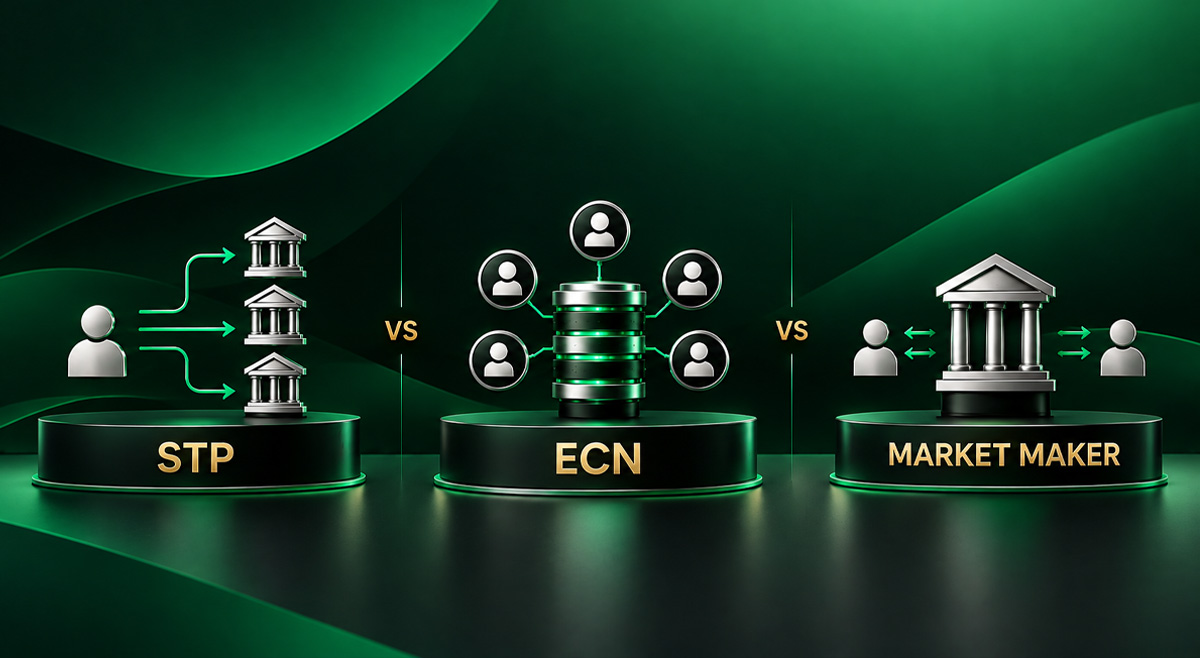
What happens after you click “buy” or “sell” on a forex platform?
The answer depends partly on the broker's execution arrangements. Terms such as STP, ECN and market maker describe different ways orders, prices and counterparties can be handled. These differences may influence spreads, commissions, available liquidity and how trades are executed.
For UAE and GCC traders comparing forex accounts, understanding these models is useful but the labels should not be treated as quality ratings. No execution structure is automatically the right choice for every trader.
What Is an STP Broker?
An STP broker uses Straight-Through Processing to electronically process or route orders, commonly to one or more external liquidity providers. The model is generally associated with automated routing rather than traditional manual dealing-desk intervention.
The important word is processing. STP describes how an order moves through execution infrastructure; it does not guarantee a particular price, spread or execution speed.
How Does STP Order Routing Work?
When a trader submits an order, the broker's system processes it and may route it to a liquidity provider according to its execution arrangements.
Liquidity providers can include banks, non-bank financial institutions and other firms supplying bid and ask prices. Where several sources are available, technology may aggregate prices or determine where an order is routed.
An STP broker may add a markup to the available spread or charge a commission. The exact structure depends on the broker and account.
How Do STP Brokers Typically Structure Trading Costs?
STP accounts are frequently associated with variable spreads because underlying liquidity conditions change.
During active trading sessions, spreads may narrow. During low-liquidity periods or major economic announcements, they can widen.
Slippage can also occur if the available market price changes while an order is being processed.
What Is an ECN Broker?
ECN stands for Electronic Communication Network. An ECN connects orders or prices from multiple market participants electronically, allowing buy and sell interest to interact within a network rather than relying on a single liquidity source.
ECN and STP are related concepts, but they are not identical. STP focuses on automated processing and routing; ECN describes an electronic network or venue through which participants can interact.
How Does ECN Order Matching Work?
An ECN can bring together liquidity from banks, financial institutions and other participants.
Pricing can therefore reflect competing bids and offers within the network. Depending on the structure available to the trader, this may result in relatively narrow raw spreads when liquidity is deep.
That does not mean spreads remain narrow under every condition. If liquidity falls or markets move rapidly, spreads can widen and available prices can change.
Why Can ECN Accounts Use Spread-Plus-Commission Pricing?
Because ECN-style pricing may present relatively tight underlying spreads, brokers commonly apply a separate transaction commission.
This highlights an important principle when comparing accounts: headline spread alone does not equal total trading cost.
A trader comparing STP vs ECN should consider spread, commission, position size and trading frequency together rather than focusing on whether an account advertises a very low minimum spread.
What Is a Market Maker Broker?
A market maker creates bid and ask prices for its clients and can act as the counterparty to their transactions. Instead of automatically routing every individual order to an external liquidity provider, the broker can internalise some client flow and manage its resulting market exposure.
This structure is commonly associated with the term dealing desk.
How Does a Dealing Desk Model Work?
When the broker is counterparty, a client's contract is directly with that broker. The firm then manages the combined exposure created by its clients.
A market maker may offset opposing client positions internally or hedge some net exposure externally. Being the counterparty therefore does not necessarily mean the broker retains every trade's market risk.
Market making can also support relatively straightforward spread-based pricing.
Does a Market Maker Always Keep Client Risk?
No.
Broker risk-management structures can be more complex than the simple “market maker versus STP” distinction suggests. A company may internalise certain exposure while hedging other exposure externally.
Potential conflicts of interest should therefore be understood and managed through appropriate policies and regulatory requirements rather than assuming that the execution label alone determines how a broker behaves.
STP vs ECN vs Market Maker: What Are the Key Differences?
The central differences concern where orders are executed, how prices are formed, who may act as counterparty and how trading costs are structured. None of these factors makes one model universally preferable.
In simplified terms:
-
STP: electronically processes/routes orders, commonly toward external liquidity providers
-
ECN: connects orders or liquidity from multiple participants through an electronic network
-
Market maker: provides prices and can act as counterparty while managing client exposure internally or through hedging
-
STP pricing: may use spread markups, commissions or both
-
ECN pricing: commonly combines variable/raw spreads with commissions
-
Market-maker pricing: can incorporate the broker's charge primarily within the spread
Actual arrangements can differ between brokers, making legal disclosures and account conditions more informative than marketing terminology alone.
Which Model Has Lower Spreads?
There is no universal answer.
ECN-style accounts can display narrow underlying spreads during liquid conditions but charge separate commissions. An STP account might have a wider spread without the same commission structure, while market-maker pricing can bundle costs into the quoted spread.
The more meaningful comparison is total transaction cost under the conditions in which the trader actually operates.
Can Slippage Occur With Every Execution Model?
Yes. Slippage can arise when the requested or expected price is no longer available when execution occurs.
Volatility, market depth, order size and liquidity can all influence fills. Neither STP nor ECN should therefore be interpreted as a promise of zero slippage or guaranteed execution at the displayed price.
Which Execution Model Should Forex Traders Consider?
There is no single execution model that is inherently suitable for every retail trader. Trading frequency, typical position size, preferred cost structure, instruments and market conditions can all affect what a trader values in an account.
Before choosing a broker or account, consider asking:
-
How does the broker describe its role when executing client orders?
-
Where can orders be executed or routed?
-
Are spreads fixed or variable?
-
Is a separate commission charged?
-
How does the broker explain slippage and order rejection?
-
Does execution differ between account types or instruments?
These questions provide more practical information than asking whether ECN is “better” than STP.
Why Do Hybrid Models Make Labels Less Important?
Modern broker infrastructure does not always fit neatly into three boxes.
Some brokers can combine internalisation with external hedging or use different execution arrangements according to instrument, exposure and account structure. Industry descriptions therefore commonly recognise hybrid approaches alongside the textbook STP, ECN and market-maker models.
For traders, that makes documentation particularly important.
Why Execution Models Matter to MENA Capital Clients
Understanding execution models helps forex traders evaluate account conditions more critically. Instead of choosing an account because it carries an STP, ECN or similar label, traders can compare the actual costs, terms and execution information available to them.
MENA Capital's current UAE account information, for example, distinguishes account structures by factors including average spreads, commissions, leverage and other trading conditions.
That provides a useful framework for comparison: evaluate spreads and commissions together, understand how leverage affects exposure, read applicable execution and account documentation, and consider regulatory status alongside trading conditions.
Execution is ultimately one component of the trading relationship. STP, ECN and market maker models explain different parts of how orders and risk can be handled, but the acronym attached to an account does not determine its suitability.
Understanding the mechanics and then examining the actual terms is more informative than choosing a broker based on an execution label alone.
Risk Disclaimer: Trading forex and CFDs involves significant risk and may not be suitable for all investors. Spreads, execution conditions, liquidity and slippage may vary according to market conditions and other factors. MENA Capital's UAE account information states that leveraged CFD and forex trading can result in significant losses. This content is for educational purposes only and does not constitute financial advice.