

What Is Leverage in Forex and How Does It Work?
 MENA Capital

 9 Min
9 Min
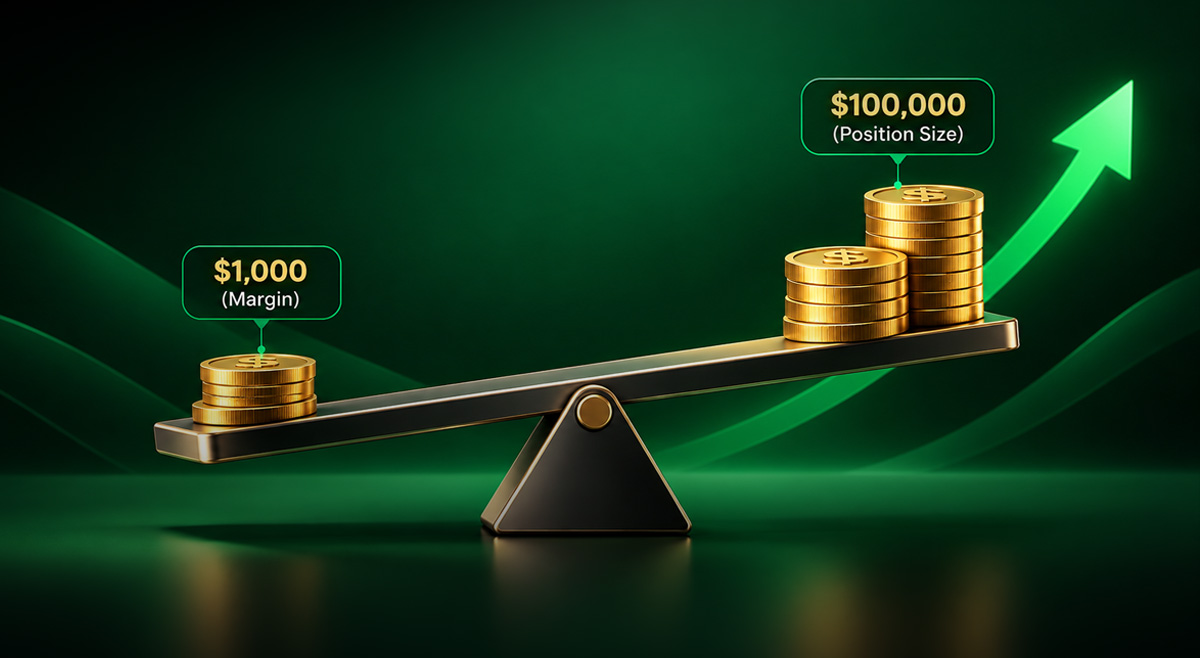
Leverage is one of the defining features of retail forex and CFD trading and one of the most important concepts to understand before opening a leveraged position.
It allows a trader to control market exposure larger than the amount of margin committed to the trade. That can make capital usage more flexible, but it also means relatively small market movements can produce much larger changes in account equity.
For UAE and GCC traders, understanding leverage therefore starts with understanding exposure, margin and risk, rather than focusing only on the maximum ratio an account offers.
What Is Leverage in Forex Trading?
Leverage in forex allows a trader to control a position whose notional value is larger than the margin required to open it. A leverage ratio such as 1:100 means that each $1 of required margin can correspond to as much as $100 of market exposure, subject to the broker's applicable trading conditions.
Crucially, leverage does not make the underlying position smaller. It changes how much capital is required to establish that exposure.
What Does a Forex Leverage Ratio Mean?
Leverage is commonly expressed as a ratio.
Some simple examples are:
-
1:10: $1 of margin can support $10 of exposure
-
1:50: $1 can support $50 of exposure
-
1:100: $1 can support $100 of exposure
-
1:200: $1 can support $200 of exposure
These examples explain the mechanics rather than suggesting an appropriate ratio. Available leverage can depend on the broker, account type, instrument and applicable requirements.
Higher leverage means less margin is needed for the same notional position—but the market exposure itself remains unchanged.
What Is Notional Value?
Notional value is the total market value represented by a position.
Suppose a hypothetical forex position has a notional value of $10,000. At 1:100 leverage, the corresponding margin requirement would be $100, assuming no additional requirements apply.
A 1% move in the position's value would still correspond to approximately $100 before considering spreads, commissions, financing, currency conversion or other factors.
Against $100 of margin, that is a substantial change. This is why leverage magnifies the impact of price movements relative to the capital committed.
How Do Leverage and Margin Work Together?
Leverage describes the relationship between market exposure and the capital supporting it, while margin is the amount of capital required to establish or maintain a leveraged position. The two concepts are mathematically connected but describe different aspects of the trade.
A 1:100 leverage ratio corresponds conceptually to a 1% margin requirement. At 1:50, the equivalent is 2%.
How Is Required Margin Calculated?
A simplified calculation is:
Required margin = position notional value ÷ leverage ratio
For example, a $20,000 position using 1:100 leverage would require $200 of margin under that simplified assumption.
In live trading, requirements can vary by instrument, account and market conditions. Brokers may also establish different margin tiers or adjust requirements according to applicable rules.
UAE rules governing OTC derivatives require relevant brokers to specify tier-margin percentages and required maintenance margin according to risk levels.
What Is a Margin Call or Stop-Out?
A margin call occurs when account equity falls relative to the margin required to maintain open positions and reaches a broker-defined threshold. A stop-out is the point at which positions may begin to be automatically closed according to the applicable account conditions.
Imagine that losses on open positions reduce account equity. As equity falls, the amount of free margin available to absorb further losses also decreases.
If the relevant threshold is reached, additional funds or reduced exposure may be required. At a stop-out level, positions can be closed automatically.
The exact thresholds should always be checked in the applicable account documentation.
What Are the Risks and Functions of Forex Leverage?
Leverage increases market exposure relative to the margin committed, so it magnifies both favourable and adverse price movements relative to that capital. It can make capital usage more flexible, but it can also cause losses to accumulate quickly when markets move against a position.
This symmetry is fundamental.
How Does Leverage Magnify Gains and Losses?
Consider two traders with the same account balance but different position sizes. The trader taking greater market exposure will generally experience a larger monetary change for the same percentage movement in the underlying market.
The danger comes from confusing available leverage with required exposure.
An account offering up to 1:100 or 1:200 does not mean the trader must use the maximum possible position size. Leverage capacity and actual risk taken are separate decisions.
Can You Lose More Than Your Initial Investment?
Potential losses depend on the product, broker terms, account protections and market conditions.
MENA Capital's current UAE risk disclosure explicitly warns that leveraged OTC derivatives, CFDs and spot foreign exchange involve significant risk of loss and that losses can exceed deposits. Traders should therefore review the applicable Client Agreement and Risk Disclosure rather than assume negative balance protection applies.
Fast-moving or gapping markets can make leverage particularly significant because prices may change rapidly.
How Should Traders Evaluate a Leverage Level?
There is no universal leverage ratio appropriate for every trader. A suitable level of exposure depends on factors such as position size, volatility, account equity, risk tolerance and the instrument being traded.
Higher available leverage is therefore not automatically an advantage.
Is Higher Leverage Better?
Not necessarily.
A higher ratio reduces the margin required for a given position, but it can also make it easier to take exposure that is large relative to account equity.
The more useful question is not “What is the highest leverage available?” but “How much market exposure am I taking relative to my account?”
How Does Position Sizing Affect Leverage Risk?
Position size determines the actual exposure being placed in the market.
Risk-management practices can include setting position size relative to account equity, understanding the monetary impact of price movements, maintaining available margin, using risk controls where appropriate, and accounting for volatility before opening a position.
A trader can have access to high leverage without necessarily using all of it.
How Does Leverage Apply to Forex Trading With MENA Capital?
MENA Capital publishes different maximum leverage levels across its UAE account structures. This illustrates why traders should review their specific account conditions rather than assume that one leverage ratio applies universally.
Current published account information lists leverage of up to 1:400 for Standard, 1:200 for Ultra, and 1:100 for Professional and Elite accounts, alongside account-specific stop-out levels. These conditions can change, so traders should confirm current terms before trading.
How Can Traders Manage Leveraged Exposure?
Understanding an account's maximum leverage is only the beginning. Traders also need to consider position sizing, available margin, volatility and how much account equity could be affected if the market moves adversely.
MENA Capital clients can combine the applicable account conditions, risk-management education and market analysis when evaluating leveraged positions.
Ultimately, leverage is a tool for controlling market exposure with margin. It does not change the direction of the market or improve the probability of a successful trade.
The key distinction is simple: leverage determines how much exposure can be controlled with a given amount of margin; position size determines how much exposure the trader actually takes.
Risk Disclaimer: Trading forex and CFDs on margin involves a high level of risk and may not be suitable for all investors. Leverage magnifies both gains and losses, and losses may exceed deposits depending on the applicable product and account conditions. Traders should understand margin requirements, account terms and the risks involved before trading. This content is for educational purposes only and does not constitute financial advice.